The right track roller matches your excavator's undercarriage dimensions, model number, and expected workload. Before you order, gather three things: the machine serial number, the undercarriage series, and the part number stamped on your existing roller. This guide explains how to measure a track roller, compare specifications, evaluate load capacity, and choose between OEM and aftermarket options. YINTAI supplies rollers for many crawler machines, so you can confirm fitment with a trusted source. Do not guess sizes. A mismatched excavator track roller wears fast and damages the chain. Measure carefully, then verify your numbers against the supplier's catalog before buying right track rollers. Track rollers that fit correctly last longer and keep your machine productive.
Measure your old track roller's diameter, width, and bolt pattern for a perfect fit.
Match the roller to your excavator model and part number to avoid wear.
Choose double-flange rollers for rough terrain and single-flange for flat ground.
Compare steel quality, seals, and warranty to get the best value.
Follow a checklist and verify fitment after installation to prevent downtime.
A track roller carries the machine's weight and rolls along the inside of the track chain. This action spreads the load during travel and keeps the chain correctly positioned. The carrier roller set supports the upper run of the chain, which prevents sagging. When you drive over stumps or rocks, the roller system manages twisting loads that could otherwise damage internal pins.
You will encounter several undercarriage parts with similar names. Bottom rollers, also called track rollers, sit under the track frame and bear the main load. Carrier rollers hold up the upper chain run. Top rollers serve the same purpose on some machines. Confirm the roller location before you order, because a carrier roller will not fit where a bottom roller belongs.
Wear is not a visual judgment. Inspectors record roller wear as a percentage during track inspections. Replace the roller when tread wear exceeds 10% of its original factory diameter or reaches manufacturer wear thresholds. YINTAI builds rollers for excavators, bulldozers, harvesters, cranes, and drilling machines, so you can source the correct undercarriage track roller for your equipment type.
The flange count determines how the roller guides the chain. A single-flange roller has one flange on the outer side. It allows more flexibility on the inner side and works well on flat, even surfaces. A double-flange roller has flanges on both sides, creating a cradle effect that fully encases the chain.
|
Feature |
Single Flange |
Double Flange |
|---|---|---|
|
Stability |
Good for straight paths |
Excellent for uneven terrain |
|
Weight |
Lighter (5-10% less) |
Heavier but more durable |
|
Cost |
20-30% cheaper |
Higher initial but lower TCO |
|
Service Life |
2,000-3,000 hours |
3,000-5,000 hours |
|
Best For |
Light-medium duty, roading |
Heavy duty, rough conditions |
|
Derailment Risk |
Moderate |
Low |
Dual flanges prevent side-to-side shifting and reduce derailments by up to 40% on uneven ground. Single flanges handle straight-line tracking well and suit high-speed travel. The wrong choice leads to misaligned tracks, damaged chain links, and more frequent part replacements. YINTAI offers single or double-flange configurations to match your machine and job conditions.
Start with the old roller. Stamped numbers fade, so your measurements define the fit. Each track roller carries the machine's weight. Every excavator track roller must match the load it carries. The correct track roller size comes from the old part.
Gather the right tools. Digital vernier calipers, micrometer tape, and ultrasonic thickness gauges give precise readings. A ruler is not accurate enough.
Measure these values:
Measure the track roller's outer diameter.
Measure the flange diameter on both sides.
Measure the overall roller width.
Measure the mounting bolt spacing.
Measure the shaft diameter.
These five dimensions define the fit. Mounting foot spacing and bolt hole configuration disqualify an incorrect roller first. Check the bolt patterns carefully. Use this sequence for all track rollers.
Now check wear. Measure the tread diameter across the narrowest worn surface. Compare it with the OEM service manual limits. Track rollers on the bottom carry heavier loads. Replace the track roller when tread wear exceeds 10% of the original factory diameter.
Inspect the inner and outer flanges. Healthy flanges keep a uniform profile with a defined radius. Worn flanges show thinned sidewalls, rounded edges, or sharp knife-like lips. Wear differences between inner and outer flanges signal frame misalignment, bent frames, improper tension, or frequent side-slope work. Track rollers excavator machines use follow these wear rules.
Track width shapes the size and specifications. Wider tracks spread the operating weight and reduce ground pressure. Wide machines need heavier track rollers. Narrower tracks improve maneuverability in tight spaces. An excavator with 100-cm tracks needs a different roller than one with 60-cm tracks. Track width sets the required size.
The excavator model and serial number narrow the search. Write down the full machine model and serial range. The OEM part number stamped on the roller is your starting point. Suppliers cross-reference that number through their catalog. Komatsu, Caterpillar, and aftermarket brands use independent catalog systems. The same part can carry different codes. Match by roller diameter, shaft diameter, flange type, link pitch, shoe width, and mounting dimensions.
Provide these details to your supplier: machine make and model, OEM part number, roller type, roller diameter, shaft length, and bolt hole spacing. When markings fade, bolt hole spacing identifies the correct part. YINTAI uses these details to locate the equivalent track roller for crawler excavator models such as KOMATSU PC20, PC200, and CAT D6D.
Cross-referencing depends on full measurements. Suppliers publish dimension tables labeled A, B, C, D, E. These show overall length, mounting width, bolt spacing, shell diameter, and bore. Suppliers list track rollers by these dimensions. Match every label to the exact machine serial range. A track roller for one series may not fit another. The part number alone is never enough. Your measurements and part number form a complete set of excavator specifications. This final check confirms compatibility.
An undercarriage track roller must match the chain link pitch and mounting bracket geometry. Verify those values. YINTAI catalogs each crawler track roller with full dimensions. Selecting the track roller for crawler excavator machines requires attention to flange design and seal quality.
Durable rollers start with quality steel. High-grade 40MnB/35MnB boron steel or 40SiMnTi alloy steel gives each track roller the strength to handle heavy loads. Manufacturers then apply quenching and tempering. This heat treatment produces a surface hardness of 58–62 HRC while keeping a tough core. The hard surface resists abrasion from rock and gravel. The tough core absorbs impact without cracking. This balance defines true durability and strength.
Seals protect the internal bearing. A floating seal keeps lubricating oil inside and blocks abrasive soil, sand, and mud from entering. The metal seal faces run against each other with a thin oil film between them. A worn seal face develops channels that pump lubricant outward and let contaminants inward. The rubber toric ring matters too. A twisted or hardened ring creates uneven face pressure. Check hub temperatures each shift to catch early seal distress. Treat any new oil line as a warning sign. YINTAI uses automated machining and consistent welding to deliver reliable seal performance on every undercarriage track roller.
Match the roller rating to your actual workload. A track roller rated for 10-ton loads suits medium excavators. Overloading a track roller track excavator strains components and shortens lifespan. Place a single-flange roller in front of the sprocket when possible. This position reduces stress on the flange.
Cost deserves careful thought. Track roller unit cost runs $100–500 each. Undercarriage maintenance accounts for roughly 40%–60% of total machine maintenance costs. Cheaper rollers save money upfront but fail sooner. A worn sleeve bearing can cause sudden roller failure. Replace the track roller before it damages the chain. Proactive swaps save about 50% compared with emergency repairs. Forged, heat-treated rollers cut total ownership cost by 25%–40%. YINTAI produces heavy-duty track rollers and standard track rollers with competitive pricing. These track rollers for excavator performance needs deliver long service life. Choose track roller material that matches your job conditions. The right track rollers excavator owners select will reduce downtime and protect your investment.
Both OEM and aftermarket options can work for your machine. Compare material quality, machining accuracy, weld quality, warranty, and price before you decide. OEM parts guarantee compatibility and use premium materials. High-quality aftermarket parts made to OEM standards can match or exceed OEM performance. Their reliability is comparable to genuine parts.
Reasonable warranty conditions from aftermarket suppliers are often more than half the OEM warranty period, which helps ensure reliability and after-sales service. Aftermarket parts should also be validated by reliability testing before use to reduce compatibility and performance risks.
Comparison
OEM
Aftermarket
Warranty periods
Manufacturer warranty coverage is cited as an OEM advantage.
Reputable suppliers offer robust warranties. Review warranty terms before purchase.
Replacement reliability
OEM parts guarantee compatibility and use premium materials.
High-quality aftermarket parts made to OEM standards can match or exceed OEM performance.
YINTAI serves as a strong example of an aftermarket manufacturer. The company offers precision-machined rollers, heat-treated steel, competitive pricing, and global customer support. YINTAI produces heavy-duty track rollers and standard track roller options for many machine models.
Ask for certifications before you pay. ISO 9001 is an accepted quality certification for undercarriage components. GFM, a Chinese excavator track chain manufacturer, holds ISO9001 international quality management system certification. CE marking confirms compliance with EU safety and environmental requirements.
|
Certification |
Relevance for global supply |
|---|---|
|
ISO 9001 |
Quality management system certification signaling consistent quality and improvement. |
|
CE marking |
Confirms compliance with EU safety and environmental requirements. |
Choose track-roller suppliers with after-sales support, replacement tracking, and return policies, and compare pricing with shipping in mind.
Lead times depend on order volume. Orders below MOQ 10 face unstable timing because production waits for a batch with other SKUs. Orders at MOQ 10 follow standard batch cycles. Bulk orders gain high predictability through dedicated production runs. Customs and consolidation issues can lengthen actual lead times. One Southeast Asia trader combined mixed SKUs to reach MOQ, but incomplete HS-code separation doubled customs clearance time. An African fleet manager mixed idlers with sprockets and seals, triggering a detailed customs review that kept excavators offline for an extra week. When you choose a track roller supplier, confirm certifications, lead times, and return policies first.
A structured process prevents costly mistakes. Follow these steps to choose the right track roller for your machine.
Clean the undercarriage thoroughly. Remove mud, concrete, and abrasive buildup from roller shells, brackets, and link pockets. Inspect shells for gouges, chips, dents, distorted brackets, or cracks along welds and bolt holes.
Measure wear precisely. Use digital vernier calipers or ultrasonic thickness gauges to measure the roller tread diameter at its narrowest worn surface. Replace the track roller when tread wear exceeds 10% of original factory diameter. Also measure track pitch across multiple link sections and replace the chain when elongation exceeds 1%–2% of factory spec.
Audit flange profiles. Inspect inner and outer guide flanges for uniform profile and defined outer-edge radius. Worn flanges show thinned sidewalls, rounded edges, or knife-like lips. Uneven inner and outer flange wear indicates frame misalignment or improper track tension.
Check for seal leaks. Inspect seal zones near end caps for wet oil residue, drips, or caked dirt rings. Seal failure causes oil escape, dry bushings, friction heat, and rapid seizure under load.
Perform acoustical and thermal diagnostics. Listen during slow tracking. Grinding or scraping sounds indicate worn rollers or failing bearings. Clicking or knocking synced with rotation points to worn chain links or pins. Use a non-contact infrared thermometer after operation. Rollers hotter than adjacent units signal lubrication failure requiring urgent replacement.
Verify track tension. Over-tight tracks increase radial loads and cause rapid tread wear, overheated bearings, and up to 15% higher fuel consumption. Under-tight tracks cause sag, chain slap, and derailment. Mid-sized excavators typically require 1–2 inches (25–50 mm) of allowable sag.
Before ordering, confirm your excavator model, serial number, and OEM part number. Photograph the machine identification plate and the roller while still installed. Record the part number by gently cleaning the marking before removal. Never guess unclear characters. Measure mounting pattern dimensions including longitudinal and transverse center spacing, hole count, hole diameter, and thread details. Send one organized data set with labeled photographs and dimensions to your supplier. YINTAI can cross-reference these details to match the correct track roller size for your machine.
After installation, inspect all parts for defects. Use a torque wrench to tighten bolts according to manufacturer requirements. Check for deep wear or cracks on the wheel surface and replace immediately if found. Verify the internal lubrication system is intact to prevent jamming or overheating. Confirm bearings are free of unusual noise or looseness.
Monitor wear patterns during operation. Even wear across the roller surface indicates correct alignment. Excessive wear on inner flanges signals track misalignment. Flat spots on the roller circumference indicate bearing seizure. One side wearing faster than the other points to frame bending or idler misalignment. Scalloping on track links indicates systemic undercarriage mismatch.
Uneven wear patterns often signal misalignment within the undercarriage system. If one side of a roller wears faster than the other, it may indicate a distorted track frame or improper installation.
YINTAI supplies heavy-duty track rollers and standard options with precision machining and heat-treated steel. These track rollers for excavator performance needs deliver reliable service life. Confirm compatibility with your supplier before the old part fails.
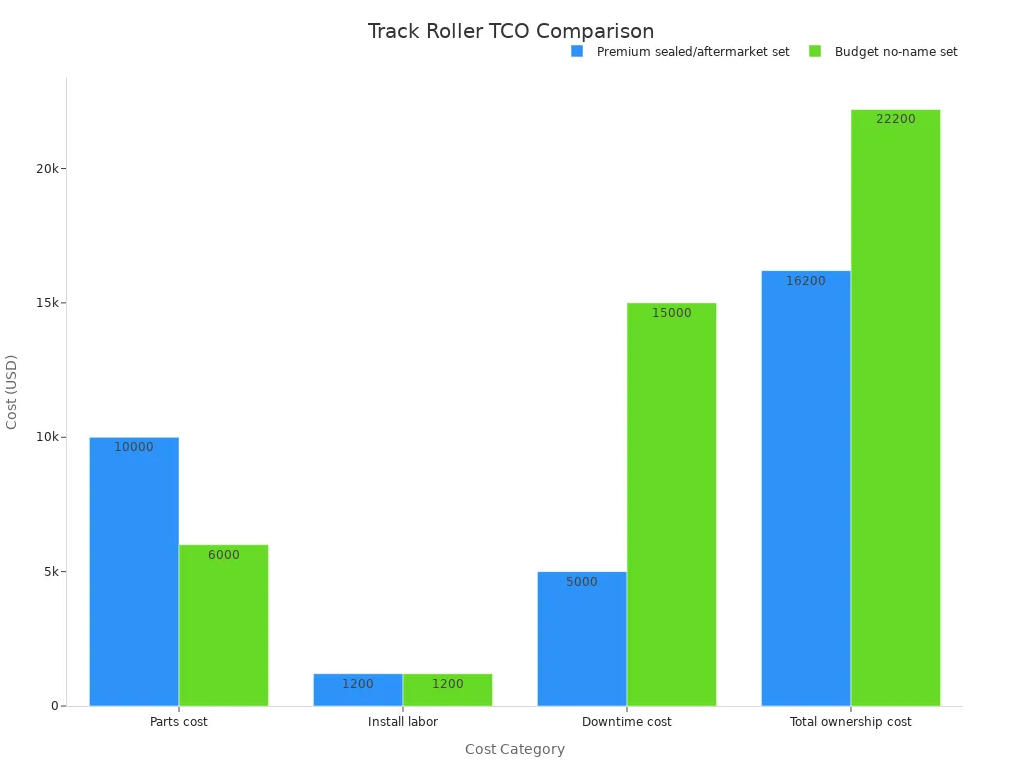
You now know the main factors: measure dimensions, match the model and part number, choose the right flange design, verify load rating, and compare supplier quality. A cheap track roller rarely saves money. For a 20–22 ton excavator, premium sealed sets cost $16,200 over 2,000 hours, while budget sets reach $22,200 — $4.63 versus $14.80 per hour.
Keep a maintenance log with part numbers and measurements. This makes future replacements faster and protects compatibility. Confirm your excavator track roller specs with YINTAI or your supplier before the old part fails, and your equipment will spend more time working and less time in the shop.
Measure the outer diameter, flange diameter, overall width, shaft diameter, and bolt hole spacing. Use digital vernier calipers for accuracy. Record the part number stamped on the track roller. Send these measurements and your machine serial number to your supplier for cross-referencing.
Choose double-flange for uneven terrain and heavy-duty work. Double flanges reduce derailment risk by up to 40%. Select single-flange for flat surfaces and high-speed travel. Place a single-flange track roller in front of the sprocket when possible to reduce flange stress.
Replace your track roller when tread wear exceeds 10% of its original factory diameter. Watch for seal leaks, grinding sounds, or hub temperatures higher than adjacent units. A worn sleeve bearing can cause sudden failure. Replace the track roller before it damages the track chain.
High-quality aftermarket track rollers can match or exceed OEM performance when built to OEM standards. Compare material quality, machining accuracy, weld quality, warranty, and price. YINTAI offers precision-machined rollers with heat-treated steel, competitive pricing, and global support. Ask for certifications and return policies before buying.
Tighten bolts with a torque wrench to manufacturer specifications. Check for unusual noise or looseness in the bearings. Monitor wear patterns during operation. Even wear indicates correct alignment. Excessive inner flange wear signals track misalignment. Flat spots indicate bearing seizure. Confirm compatibility with your supplier before the old part fails.
get latest company news
Xiamen Yintai Machinery Co., Ltd


 ipv6 network supported
  sales & support 8613696958576
 Email : binochen@yintparts.com