When an excavator undercarriage component becomes worn or damaged, one important question comes up: should you replace only the affected part, or replace several components as a complete set? The answer depends on the condition of the entire undercarriage, the wear relationship between connected parts, and the cost of future maintenance.
In general, individual replacement is suitable when one component has isolated damage and the surrounding parts are still within acceptable wear limits. Replacing parts in sets is often a better option when multiple components have similar wear levels, when connected components no longer work together properly, or when repeated repairs would increase downtime and maintenance costs.
For excavator owners, fleet managers, and construction equipment distributors, understanding when to replace individual undercarriage parts and when to replace them in sets can help control operating expenses while maintaining reliable machine performance.
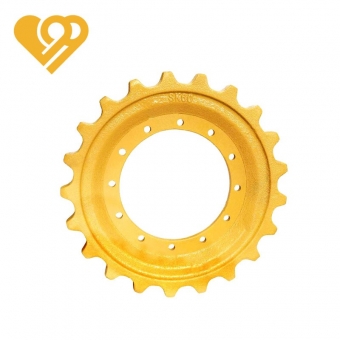
Excavator drive sprocket used in the crawler undercarriage system.
Yes. Excavator undercarriage parts can be replaced individually when the damage or wear is limited to one component and the surrounding parts remain in suitable operating condition.
For example, if one bottom track roller develops an oil leak while the other rollers still rotate smoothly and show acceptable wear, replacing the affected roller may be a reasonable solution.
Individual replacement is generally worth considering in the following situations:
However, replacing only one component does not automatically mean the repair is complete. The surrounding parts should also be inspected to determine why the original component failed and whether the new part can operate correctly with the existing assembly.
For instance, a damaged track roller may be related to incorrect track tension, misalignment, or uneven wear elsewhere in the undercarriage. If the underlying problem is not corrected, the replacement roller may experience similar damage.
Replacing several undercarriage components together becomes more practical when their wear conditions are closely related or when one worn component has already affected the performance of another.
A complete or partial set replacement may be recommended in these situations:
Multiple components have reached their wear limits. If several rollers, sprockets, or track chain components are approaching their manufacturer-specified replacement limits, replacing them together can reduce the need for repeated maintenance.
Connected components have incompatible wear conditions. A new component operating against a severely worn mating component may experience abnormal contact and accelerated wear. This is particularly important when replacing track chains and sprockets.
Repeated repairs are becoming expensive. If the machine frequently requires individual undercarriage repairs, the combined cost of replacement parts, labor, and downtime may eventually exceed the cost of a planned set replacement.
The machine is operating in demanding conditions. Excavators working in mining, quarrying, rocky ground, or highly abrasive environments may experience more uniform and accelerated wear across several undercarriage components.
A major maintenance shutdown is already scheduled. Replacing several worn components during one maintenance period can reduce repeated machine stoppages and improve maintenance planning.

Front idler components should be inspected together with the track chain and other contacting parts.
It is important to understand that replacing parts in sets does not always mean replacing every component on both sides of the machine. A partial replacement may be sufficient if inspection results show that only one section of the undercarriage has reached its service limit.
Not every undercarriage component needs to be replaced at the same time. The most important consideration is how the components interact during machine operation.
Track Chain and Drive Sprocket
The track chain and drive sprocket work together to transfer driving force and move the excavator. Their contact surfaces gradually wear during operation.
When track chain pitch elongates significantly, the chain may no longer engage correctly with the sprocket teeth. This can accelerate sprocket wear and increase the risk of abnormal movement or premature failure.
If the track chain is severely worn, the sprocket should be carefully inspected before installing a new chain. If the sprocket teeth are also beyond the manufacturer's wear limits, replacing both components together is generally the better option.
However, if the sprocket remains within acceptable wear limits and has a compatible tooth profile, replacing the chain alone may be sufficient.
For replacement requirements, buyers can review the excavator and bulldozer track chain product range and the corresponding drive sprocket and segment products to check the available configurations.
Bottom Track Rollers
Bottom track rollers support the machine's weight and guide the track chain along the lower undercarriage. They are exposed to continuous pressure, vibration, friction, and abrasive materials.
If one roller develops a seal failure, unusual noise, or localized damage, individual replacement may be appropriate. However, if several rollers on the same side have similar wear or reduced tread dimensions, replacing them as a group may provide more consistent support.
When evaluating replacement requirements, compare roller diameter, flange wear, surface condition, and rotation performance. Also inspect the track chain contact surfaces to identify possible causes of uneven wear.
Yintparts manufactures different types of excavator bottom track rollers, including friction welding and traditional welding roller designs.
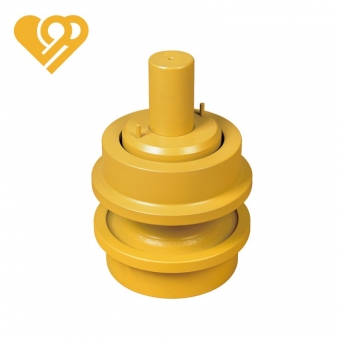
Bottom track rollers carry machine weight and support track chain movement.
Carrier Rollers and Front Idlers
Carrier rollers support the upper track chain, while front idlers help guide the track and maintain its alignment. Both components influence track movement and overall undercarriage operation.
If a carrier roller has a localized seal problem or mechanical failure, it may be replaced individually after checking the surrounding components.
For front idlers, inspect the wheel surface, flange condition, bearings, and alignment. If the idler has severe structural wear or no longer guides the chain correctly, replacement may be necessary.
When the track chain, carrier roller, and front idler show different wear conditions, each component should be evaluated separately rather than automatically replacing everything together.
Track Shoes and Track Chain Assemblies
Track shoes are attached to the track chain and provide ground contact and traction. Their condition affects machine stability, traction, and ground pressure.
If only one or two track shoes are bent, cracked, or damaged, individual replacement may be possible when the remaining shoes and connecting hardware are in good condition.
However, if the track shoes show extensive wear, cracks, or repeated damage across the entire assembly, replacing a complete track shoe group may be more practical.
Check shoe width, grouser height, bolt-hole spacing, and compatibility with the existing track chain before ordering replacement components.
Buyers can explore the excavator and bulldozer track shoe assemblies for different crawler equipment applications.

Track shoes should be checked for grouser wear, cracks, and mounting damage.
The most reliable way to make this decision is to inspect the entire undercarriage and compare the condition of each component with the manufacturer's wear specifications.
Start by cleaning the undercarriage so that cracks, leaks, worn surfaces, and damaged mounting areas are easier to identify. Then measure the important dimensions and record the condition of each component.
The following comparison can help maintenance teams decide which replacement approach is more suitable:
| Inspection Condition | Recommended Approach |
|---|---|
| One component has isolated damage | Individual replacement |
| Other connected parts remain within wear limits | Individual replacement may be suitable |
| Several components have reached their wear limits | Partial or complete set replacement |
| New and old mating components have incompatible wear profiles | Replace the affected matched components |
| Repeated individual repairs cause excessive downtime | Consider planned set replacement |
| One side has significantly more wear than the other | Inspect both sides and replace according to measured condition |
There is no universal wear percentage that determines when every excavator undercarriage part must be replaced. Track chains, rollers, sprockets, and idlers have different wear characteristics. Always use the relevant OEM inspection chart and measurement limits for the specific machine.
For example, replacing a single leaking roller may be reasonable if the surrounding rollers are still within their service limits. However, replacing a severely worn track chain while keeping a badly worn sprocket may create a new compatibility problem.
At first glance, replacing one undercarriage component is usually less expensive than purchasing a complete set. However, the actual maintenance cost involves more than the initial parts price.
When comparing the two options, consider the following expenses:
Replacement part cost: Individual replacement requires a smaller initial purchase, while set replacement may require a higher upfront investment. However, purchasing multiple compatible components together may help simplify procurement and delivery arrangements.
Labor cost: If several parts are expected to fail within a short period, replacing them during one maintenance operation may reduce repeated labor expenses.
Machine downtime: Every maintenance shutdown affects equipment availability. Replacing several worn components during planned maintenance may be more efficient than repeatedly stopping the machine for individual repairs.
Secondary damage: Installing a new component alongside a severely worn connected part may shorten the service life of the replacement. The resulting repair cost can be greater than the initial savings.
Future maintenance planning: A complete inspection and coordinated replacement plan can make it easier to forecast future spare parts requirements and manage inventory.
For equipment distributors and fleet operators, the best option is not necessarily the one with the lowest initial purchase price. It is the solution that provides a reasonable balance between component compatibility, expected service life, labor, and operating costs.
Whether you decide to replace one component or a complete set, accurate product identification is essential. Incorrect dimensions or incompatible parts can cause installation problems and additional maintenance work.
Before requesting a quotation, prepare the following information:
It is also worth checking the related front idler assemblies and other undercarriage components when evaluating the overall condition of the crawler system.
For fleet operators, keeping a record of replacement dates, operating hours, wear measurements, and part numbers can make future maintenance decisions much easier.
Choosing between individual and set replacement also depends on whether the supplier can provide the required components with suitable specifications and consistent quality.
Xiamen Yintai Machinery Co., Ltd. (Yintparts) specializes in manufacturing excavator and bulldozer undercarriage components and ground engaging tools. Its product range includes track chains, track shoes, bottom rollers, carrier rollers, front idlers, sprockets, bucket teeth, adapters, and other related spare parts.
Yintparts uses professional quenching, tempering, machining, forging, and welding processes to manufacture different undercarriage components. The company also provides customized products according to customer samples, designs, and technical drawings.
For buyers who need to replace several related components, confirming the machine model and technical specifications across the order helps ensure that the selected parts are suitable for the intended application.
Whether you need an individual replacement component or several undercarriage parts for a maintenance project, Yintparts can discuss the requirements based on your machine application and product specifications.
To help the team evaluate your requirements, prepare the following details:
Providing these details helps the supplier understand the actual maintenance requirement rather than simply quoting products based on general machine information.
Can you replace excavator undercarriage parts individually?
Yes. Individual replacement is suitable when one component has isolated damage or wear and the surrounding parts remain within acceptable manufacturer limits. The related components should still be inspected to ensure compatibility.
Should excavator undercarriage parts always be replaced in sets?
No. Replacing every component in a set is not always necessary. The decision depends on wear measurements, component compatibility, machine operating conditions, and maintenance costs. Individual or partial replacement may be sufficient when other components remain in good condition.
Should I replace the excavator track chain and sprocket together?
Not necessarily. If the track chain is worn but the sprocket remains within acceptable wear limits and is compatible with the replacement chain, replacing the chain alone may be suitable. If the sprocket teeth are also severely worn, replacing both components together is generally recommended.
Should all excavator bottom track rollers be replaced at the same time?
Not always. A single damaged roller can be replaced individually if the other rollers remain within their wear limits. If multiple rollers show similar wear, leakage, or reduced dimensions, replacing several rollers together may provide more consistent support.
Can I replace only one side of an excavator undercarriage?
Yes, when inspection confirms that the wear or damage is concentrated on one side. However, both sides should be measured and compared to identify uneven wear and ensure that the machine maintains suitable operating performance.
What happens if I install new undercarriage parts with severely worn components?
Severely worn mating components may cause abnormal contact, uneven load distribution, and accelerated wear on new parts. This is particularly important for track chains and sprockets, which must work together correctly.
How do I know whether excavator undercarriage parts need replacement?
Inspect the components for cracks, oil leaks, abnormal noise, flat spots, damaged teeth, and excessive wear. Measure important dimensions and compare them with the manufacturer's wear limits before deciding whether individual or set replacement is necessary.
Does replacing undercarriage parts in sets reduce maintenance costs?
It can reduce repeated labor expenses and machine downtime when several components are approaching their replacement limits. However, unnecessary set replacement can increase initial costs. The best approach depends on the actual condition of the undercarriage.
Can Yintparts supply individual excavator undercarriage parts and complete sets?
Yintparts manufactures a range of excavator and bulldozer undercarriage components, including track chains, track rollers, carrier rollers, front idlers, sprockets, and track shoes. Buyers can discuss individual or multiple-component requirements according to machine specifications and application needs.
Replacing excavator undercarriage parts individually or in sets is ultimately a maintenance decision based on actual wear, component compatibility, and operating costs. A careful inspection before ordering helps prevent unnecessary replacement while protecting the service life of the remaining undercarriage components.
For replacement requirements, contact Yintparts with your machine model, component details, and required quantities to discuss suitable excavator and bulldozer undercarriage solutions.
get latest company news
Xiamen Yintai Machinery Co., Ltd


 ipv6 network supported
 sales & support 8613696958576
 Email : binochen@yintparts.com