An excavator track roller supports the weight of the machine on the ground. A carrier roller guides the upper track chain instead. This simple split gives you a clear mental model for the undercarriage of tracked machinery.
You will find bottom rollers along the lower track frame. They carry the full load of your crawler excavator. Top rollers sit higher and keep the track loop aligned. This difference matters for wear, maintenance, and replacement decisions. Track rollers and carrier rollers wear at different rates. Each type needs its own inspection schedule. Understanding these roles helps you protect the excavator's undercarriage and avoid costly downtime.
Track rollers carry the machine's weight on the ground. Carrier rollers guide the upper track chain. This core difference drives all maintenance decisions.
Bottom rollers absorb heavy loads. They wear faster than top rollers. Inspect them daily to catch damage early and avoid costly downtime.
Carrier rollers face lighter loads. They can seize from seal failure. Check rotation and seals regularly to prevent track misalignment.
Choose rollers for your exact machine model. Verify dimensions and quality before installation. This ensures a smooth fit and long service life.
Maintain correct track tension. Clean rollers daily. These simple habits extend roller life and keep your excavator working.
You will find an excavator track roller, also called a bottom roller, on the lower frame—the lower part of the undercarriage. Its location and function are direct: these wheels carry the machine's full operating weight. Bottom rollers press onto the track shoes and support the weight of the machine on the ground, spreading force across the track's contact area.
The spacing and number of track rollers set the ground pressure. A balanced arrangement creates an even pressure profile, stopping the machine from sinking and keeping it stable on uneven terrain. A large excavator runs six to twelve rollers per side, with wider spacing in the middle and denser spacing at the ends. Each roller also supports the weight of the track chain as it loops beneath the frame, holding the chain aligned with the sprocket and idler.
A track roller that seizes triggers a cascade. Its load shifts to neighboring bottom rollers, and those units wear faster. That reaction can damage the whole track assembly. Each roller matters more than its size suggests.
These rollers also face constant stress. Radial loads press straight down through the axle, forming the dominant force. Axial loads push sideways during turns or on slopes. The roller flange clamps the chain track, preventing lateral derailment and keeping the machine straight.
Every excavator track roller resists impact and wear through its construction. Its outer shell uses high-carbon steel, through-hardened to roughly 55–60 HRC across the full thickness. That hardness shrugs off abrasion from rocks, concrete, and soil. Shells forged from 40Mn2 or 50Mn alloy steel provide a compact internal structure with higher strength than cast steel.
Inside, tapered roller bearings manage radial and axial loads. Multi-lip seal systems, often floating oil seals, protect the bearings from mud, water, and abrasive fines. Seals keep grease in and contamination out, a must for wet or dusty job sites.
A bottom roller's dimensions must match the machine's weight class. Medium excavators use seven to nine rollers per side. Common diameters include 101mm, 135mm, and 175mm, with mounting holes aligned to the chassis.
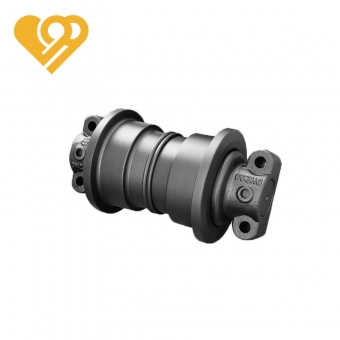
A carrier roller sits on the upper part of the undercarriage. This top roller holds the return section of the track chain. It does not touch the ground. Instead, it keeps the chain from drooping as the chain travels between the front idler and the rear sprocket.
The excavator carrier roller performs three key jobs. First, it prevents the upper track from sagging under its own weight. Second, it helps maintain proper track tension. Third, it keeps the chain aligned so the links stay engaged with the sprocket teeth. A track carrier roller also reduces track swing during turns. This action keeps the chain in contact with the frame and allows balanced power transfer.
| Mechanism | How It Works |
|---|---|
| Positioned at the top between sprocket and tensioner | Supports the upper track chain and stops sagging or misalignment |
| Works with rollers, idlers, and sprockets | Regulates tension so links stay engaged for smooth movement |
| Guides the upper chain during turns | Prevents track whipping and derailment |
| Absorbs shocks on rough terrain | Maintains the specified 2–3% track sag |
You will find one to three carrier rollers per side. They support the weight of the track chain on its return journey. These rollers guide the track chain around the sprocket and idler wheels without carrying the machine's load.
Upper carrier rollers share a common build. Manufacturers use high-strength alloy steel and wear-resistant rubber for impact resistance. Precision casting and forging give the body structural strength. Heat treatment and surface treatment follow to improve fatigue resistance.
A top roller works as a sealed unit. It holds its own bearings and lubrication. Durable seals keep out mud, debris, and water. A floating oil seal is a common choice, and this design retains oil and blocks contaminants. Seal failure is the leading cause of roller failure, so this arrangement matters.
Flange design also plays a role. Flanged rollers guide the track chain, stop twisting, and improve stability on slopes or during turns.
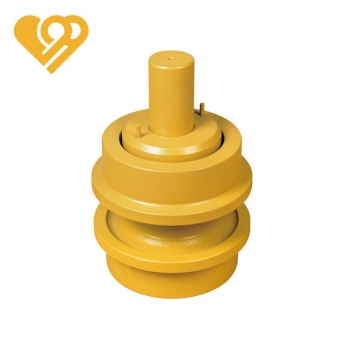
The primary functional difference between a carrier roller vs track roller comes down to one idea: the excavator track roller supports the weight of the machine on the ground, while a carrier roller guides the slack upper chain. You can remember this distinction by studying the undercarriage. Bottom rollers absorb the brutal forces of digging and travel. Top rollers manage the loose chain as it cycles back toward the sprocket. This split drives every practical decision, from inspection priorities to replacement timing.
Position sets the job. Track rollers along the lower frame press directly onto the track shoes. These load-bearing units carry the machine's full operating weight. A counterpart set sits near the top of the frame. Carrier rollers handle only the return side of the chain, supporting the track chain's own weight and distributing it evenly along the frame.
| Feature | Bottom track rollers | Top carrier rollers |
|---|---|---|
| Primary role | Support the machine's operational weight on the ground | Support the track's return section and maintain alignment |
| Weight load | Carry the machine's full operating weight | Support the return chain's own weight |
| Ground impact | Absorb shock from rough terrain | None—never touch the ground |
| Load distribution | Spread weight across the track shoe contact area | Evenly distribute the chain's weight |
The main difference between bottom rollers and carrier rollers extends to track guidance. Bottom track rollers keep the lower chain pressed onto the ground for traction. Their flanges guide the track chain around the sprocket and idler wheels. Upper rollers perform a lighter task: they guide the track chain along the top run, preventing sag between the idler and the sprocket.
The difference between bottom rollers and carrier rollers becomes obvious during operation. Digging force, travel impact, and static load all flow through the lower units. Carrier rollers only feel the tension of the moving chain. That explains why a track roller uses a thicker shell and larger bearings. A carrier roller uses lighter construction because its loads stay far smaller.
These different roles of track rollers and carrier rollers produce distinct wear patterns. The heavy units fail through surface contact. You will see flat spots, shell cracks, deep scoring, or an unusual polished band across the tread. Flange wear appears as sharp edges, one-sided rubbing, or contact marks on the chain. Seal leakage shows up as oil wetness around the end cap, dirty buildup, or drips on adjacent parts. A damaged bottom roller needs immediate attention, since failure shifts its load to neighboring rollers.
The upper units fail differently. Their treads last longer because they face less load. Real problems happen internally. Bearing deterioration, restricted rotation, binding, and excessive noise signal a failing top roller. Your inspection should focus on rotation, lubrication, and alignment, rather than the flat-spot checklist used for bottom units.
The primary difference also affects replacement timing. The ground-contact rollers wear faster because they absorb impact every cycle. The upper units still deserve regular inspection, since a seized top roller can misalign the chain and accelerate wear in the sprocket and idler. Replace a roller with a damaged flange before it derails the chain. For the upper units, maintenance means keeping seals clean and confirming free rotation.
Matching a replacement part to your machine starts with accurate identification. Give your supplier the exact equipment model, undercarriage nameplate details, or OEM part numbers before you order. Ask technical specialists to verify mounting hole spacing, shaft diameter, and overall height. These checks confirm a seamless fit for your excavator track roller or carrier roller.
Cross-brand compatibility depends on precise manufacturing. Reputable makers maintain comprehensive OEM part number databases and use high-precision CNC machining to control mounting hole pitch, shaft diameters, flange widths, and spline specs. This approach delivers precise matching with mounting standards across major global brands and many machine models.
Different machines demand different fit priorities. Some machines need carrier rollers with floating oil seals because of strict sand and gravel ingress protection. Others require forged high-strength steel roller bodies for high-impact forces. Still others emphasize smooth movement, so their carrier rollers must meet precise machining standards.
A reputable manufacturer produces undercarriage parts with quench-tempering and precision machining. The company offers standard or custom replacement components for major brands, and you can submit samples, designs, or technical drawings to match OEM specifications.
Inspect several quality indicators before you buy. The table below summarizes what to check and the acceptance criteria for each point.
| Quality Indicator | What to Check | Acceptance Criterion / Note |
|---|---|---|
| Surface hardening / heat treatment | Confirm whether tread surfaces are induction-hardened or through-hardened | Hardening resists abrasive wear from track links and ground contamination |
| Precision machining | Check tolerances on shaft diameters, mounting faces, and bores | Tight tolerances ensure accurate alignment with the track chain and frame |
| Sealing systems | Inspect for multi-lip seals or floating oil seals | Seals keep lubrication in and keep dirt, water, and mud out |
| Internal bearings | Confirm high-capacity bearings or bushing systems | Bearings support loads and allow smooth rotation under side loads and shock |
| Lubrication | Verify correct lubricant type and quality | Correct lubrication reduces friction and heat, extending roller life |
Material strength follows measurable specifications. Surface hardness should reach HRC48–56, and quenching depth should measure 6–10 mm. Machining tolerance for bearing holes and installation dimensions should be held to tight tolerances. Roller rim hardness should fall in the HRC48–56 range. Ask for effective case depth and hardening details, and avoid a thin hardened skin that wears quickly and exposes the soft core. Forged rollers generally resist fatigue better than cast ones, so confirm the manufacturing process. For sealed track chains, compare seal materials for temperature and wear resistance.
You should inspect your track rollers and carrier rollers whenever you service the machine. Watch for a thin oil line around the end cap with dust stuck to it. That pattern means the seal is passing, and abrasive material now sits against the joint. Compare hub temperature with a neighboring roller to confirm the problem.
A flat spot on the tread with a polished look tells you the roller stopped rotating and is being dragged. Check whether it turns by hand. Wear concentrated on the flange with a sound tread points to an alignment problem, so check the frame before you replace the part. Loose mounting bolts signal an installation issue. Cracks in the shell or mounting brackets mean structural failure from impact or fatigue.
Bottom rollers usually wear faster because they carry more load. A seized carrier roller still demands attention. It causes track misalignment, excessive sag on the return side, and collateral damage to other undercarriage parts. Listen for grinding, squeaking, or rattling. These noises indicate a worn or damaged roller that can reduce performance.
| Visible sign | What it indicates | Confirming check |
|---|---|---|
| Thin oil line around the end cap with dust stuck to it | Seal is passing; abrasive material held against the joint | Compare hub temperature with neighboring roller; check grease condition at plug |
| Flat spot on the tread with polished appearance | Roller has stopped rotating and is being dragged | Check whether it turns by hand; whether flat is in one place or repeated around circumference |
| Wear concentrated on the flange with sound tread | Roller is being asked to guide more than designed | Check alignment and frame before replacing roller |
| Loose hardware / mounting bolts | Incorrect fitting or installation issue | Inspect contact marks, lateral wear, loose hardware, component measurements |
| Cracks in shell or mounting brackets | Structural failure from impact or fatigue | Visual inspection of shell, welds, and mounting bolt holes |
Safety comes first when you replace an excavator undercarriage roller. Park and lock out the machine on firm, level ground. Lower all attachments and relieve hydraulic pressure. Lift and secure the frame on certified support stands. Never work under hydraulics alone.
Clean the undercarriage with a pressure washer before you start. Mud, clay, and debris hide hairline cracks and oil weeping. Use a large flat-head screwdriver or pry bar to maneuver track edges. A wrench or socket set accesses the grease valve and inspection plates. Keep a grease gun loaded with high-quality lithium grease nearby.
Confirm each new roller matches your machine model. Check the bolt pattern, shaft diameter, flange configuration, and working width. Install mounting bolts by hand first to prevent cross-threading. Tighten bolts evenly in a crisscross or star pattern. Use a calibrated torque wrench for final torque, following the OEM service manual value for your exact machine and bolt grade. No universal number exists because frame size, bolt diameter, and grade vary.
Spin the roller by hand after installation. It should rotate freely without drag. Restore track tension to the measured sag spec. Run the track slowly for a full revolution while a spotter watches the fresh roller and its seals. After the first hours of work, re-check bolt torque and the seal area. Bolts settle as the machine works, and this first-hours re-torque is the step most shops skip.
Routine maintenance protects your excavator undercarriage from early failure. You extend the life of the undercarriage of tracked machinery with daily checks, cleaning, and correct track tension.
Perform a daily visual inspection each morning. Look for oil leaks around roller hubs, loose bolts, cracked welds, and missing hardware. Check sprocket teeth for uneven wear, and inspect rubber parts for deep cuts. Clean the complete track loop daily, matching a normal working day. In wet, muddy, or dusty environments, clean more frequently, multiple times per day, to prevent corrosive buildup.
Rigorous, daily removal of packed mud, rocks, and debris is critical. Daily cleanout reduces abrasive grinding against moving parts, allows proper cooling, helps prevent seal tearing, and reduces corrosion.
Focus extra attention on bottom rollers; they absorb the worst impact on every cycle. Track rollers and carrier rollers fail faster when packed debris traps heat and grinds against seals. Schedule weekly checks for track tension sag, roller flanges, and sprocket teeth. Monthly, measure tread diameters and compare hub temperatures.
Track tension directly affects roller longevity. Over-tight tracks increase radial loads on the rollers and idlers, causing rapid tread and flange wear, overheated bearings, increased fuel consumption, and premature chain stretch. Under-tight tracks create excessive sag, allowing the chain to slap against rollers, climb flanges, and derail. Mid-sized machines require 2–3% track sag. Set that sag with the grease-filled cylinder on the recoil assembly.
Modern rollers come sealed and lubricated, so you do not need to grease them on a schedule. Inspection replaces lubrication: check seal zones near the end caps for wet oil residue or sticky dirt rings, and inspect the seal rings for aging or cracking. Listen for grinding or squealing during slow tracking. Compare roller temperatures with a non-contact infrared thermometer after work. A significantly hotter roller indicates lubrication failure and needs replacement.
Track rollers carry the excavator's weight on the ground. Carrier rollers guide the return section of the track above. This split shapes everything. Ground-contact rollers wear faster from impact and load. Upper rollers fail more from seal leaks and bearing seizure. Each type affects track alignment and replacement timing in its own way. Inspect both regularly. Follow the manufacturer's maintenance schedule. Replace worn parts with quality components. These habits protect your excavator's undercarriage and extend its service life. A seized carrier roller can misalign the chain. A worn track roller can shift load to its neighbors. Catch both early, and your machine keeps working.
Here are quick answers to common questions about bottom and top rollers, from interchangeability to wear detection.
No. An excavator track roller carries the machine's weight. A track carrier roller only guides the upper chain. They differ in size, bearing capacity, and shell thickness. Installing the wrong roller risks premature failure and track misalignment.
The bottom track roller wears faster. It supports the machine's full operating weight. The upper roller faces lighter loads. Inspect both regularly. Expect the bottom roller to need replacement sooner.
Check for oil residue around the end cap. Listen for grinding noises. Watch for restricted rotation. A seized excavator carrier roller misaligns the track chain. Compare hub temperature with the other top rollers. A hotter upper roller signals bearing trouble.
Flat spots affect any of the excavator undercarriage rollers. In practice, they appear on bottom rollers. A flat spot means the roller stopped turning. The machine drags it, grinding a polished band into the tread. Check rotation by hand. Replace the damaged roller.
Keep track sag at 2–3% for mid-sized machines. An over-tight track overloads the carrier roller and idlers. A loose track slaps the upper roller and climbs flanges. Measure sag with the machine on level ground. Adjust through the grease-filled cylinder.
get latest company news
Xiamen Yintai Machinery Co., Ltd


 ipv6 network supported
  sales & support 8613696958576
 Email : binochen@yintparts.com