When purchasing excavator track shoe assemblies, buyers should look beyond the appearance of the steel track pads. A reliable assembly must meet the required material specifications, dimensional tolerances, hardness requirements, fastening standards, and overall manufacturing quality. Even a small defect in a track shoe or track link can affect installation, track alignment, and the service life of the entire undercarriage system.
So, what quality checks should be performed on excavator track shoe assemblies? Buyers should inspect raw materials, track shoe dimensions, bolt holes, grouser profiles, heat treatment results, surface defects, and assembly compatibility. For welded track shoe designs, weld quality must also be checked. This guide explains the essential inspection points and how buyers can evaluate a manufacturer's quality control process before placing an order.
An excavator track shoe assembly is an important part of the undercarriage system. It provides ground contact, supports machine movement, and transfers traction to the working surface. Depending on the product design, a track link group assembly may include track links, track shoes, track bolts, and nuts.
These components operate under repeated impact, bending forces, abrasion, and changing ground conditions. If the steel quality is inconsistent or the heat treatment is inadequate, the track shoe may wear too quickly, bend, or develop cracks during operation. Incorrect dimensions can also cause installation difficulties or poor compatibility with the track chain.
For equipment owners, distributors, and construction machinery parts wholesalers, proper inspection helps reduce the risk of premature replacement and unexpected maintenance costs. It also helps buyers compare different suppliers based on measurable quality standards rather than price or product appearance alone.
Raw material quality is the starting point of a reliable excavator track shoe. Buyers should confirm the steel grade, material consistency, and relevant material documentation before approving production.

Different applications require different material specifications. For example, Yintparts offers 25MnB steel excavator track pads. Its product information describes the use of high-grade steel and through-hardening processes to improve strength and wear resistance.
During material inspection, buyers should pay attention to the following points:
A low-cost track shoe made from unsuitable steel may initially look similar to a higher-quality product. However, differences in material composition and mechanical properties can become apparent after extended operation. This is why material verification should be part of the incoming quality control process.
Dimensional inspection is one of the most important quality checks for excavator track shoes. A track pad may have the correct appearance but still fail to fit if its width, bolt-hole spacing, or installation dimensions do not match the machine requirements.
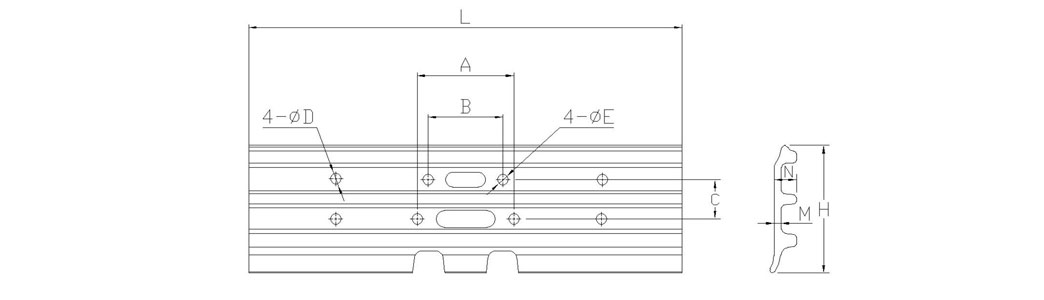
Buyers should compare the finished product with the correct OEM drawing or approved technical specification. The main dimensions to inspect include:
Yintparts publishes installation dimension references for different excavator models, including PC300, PC400, EX200, PC200, EX120, and other machines. For example, its published reference for the PC300/EX300-5/EX350LC-5/ZAX300/SH330 group lists dimensions A, B, C, E, and H as 178.4, 140.4, 76.2, 22.8 mm hole diameter, and 250 respectively, according to the product drawing.
These figures are model-specific references, not universal dimensions for all excavator track shoes. Buyers should confirm the exact machine model, drawing revision, and required tolerances before ordering. A dimensional inspection report should record both the nominal dimensions and actual measured values.
You can also review Yintparts' excavator and bulldozer track shoe product range to compare different track shoe designs and applications.
Track shoes experience continuous contact with soil, gravel, rocks, and other abrasive materials. Therefore, hardness and heat treatment quality have a direct influence on wear resistance and service performance.
Yintparts describes its track shoe manufacturing process as including through hardening with spray quenching and tempering. These processes help improve the strength and wear resistance of the steel, reducing the risk of bending and breaking under demanding working conditions.
Buyers should request the applicable heat treatment and hardness inspection records. Important checks include:
It is important to understand that higher hardness does not automatically mean better performance. The correct hardness depends on the steel grade, component design, heat treatment process, and intended working conditions. Excessive hardness without adequate toughness may increase the risk of cracking under impact loads.
For this reason, buyers should evaluate hardness together with material properties, heat treatment requirements, and the manufacturer's technical specifications instead of using one hardness value as the only quality standard.
The grouser is the raised section of a track shoe that provides traction between the machine and the ground. Its shape, height, thickness, and structural consistency influence how the machine performs on different surfaces.
During inspection, buyers should look for uneven grouser heights, irregular profiles, excessive machining marks, and visible damage. The plate should also have consistent thickness according to the approved drawing.
Different working environments may require different track shoe designs. Single-grouser track shoes are commonly used for general earthmoving applications, while wider swamp shoes are designed to improve flotation on soft or marshy ground. Round-hole and other special track pad designs may also be selected according to mud discharge and operating requirements.
For example, Yintparts provides bulldozer single-grouser track pads and other track shoe designs for different crawler machine applications. Buyers should select the appropriate structure according to the machine, ground conditions, and required traction rather than choosing a shoe based only on its width or appearance.
For bolted track shoe assemblies, the connection between the track shoe and track link must be secure and correctly fitted. Incorrect hole dimensions, damaged threads, or unsuitable fasteners can cause installation problems and loosening during operation.
The inspection should cover the following details:
Fastener quality should not be overlooked. Yintparts offers excavator and bulldozer bolts and nuts, including track shoe fasteners. Its product information includes Grade 10.9 and 12.9 fastener options. The appropriate grade and dimensions should always be confirmed against the equipment manufacturer's requirements.
If the purchased product is a complete track link group assembly, buyers should also check the relationship between the track links, shoes, bolts, and nuts. Yintparts' excavator track link group assembly is described as including these components, making overall assembly compatibility an important inspection point.
Not every track shoe uses a bolted connection. Some smaller excavator models use welded track shoe designs, where the track shoes are welded directly onto the track links. In these products, welding quality becomes an additional inspection requirement.
Buyers should inspect the following welding characteristics:
Visual inspection is a useful first step, but it cannot identify every internal welding defect. Where the product specification requires it, suitable non-destructive testing methods such as magnetic particle testing may be used to identify surface or near-surface discontinuities in ferromagnetic materials.
The inspection method should match the joint design, material, welding process, and applicable acceptance criteria. Buyers should not assume that every track shoe assembly requires the same welding inspection because many designs are bolted rather than welded.
Surface inspection helps identify manufacturing defects that may affect product quality, protection, or installation. It should be performed after the relevant machining and surface treatment processes.
A final appearance inspection should focus on:
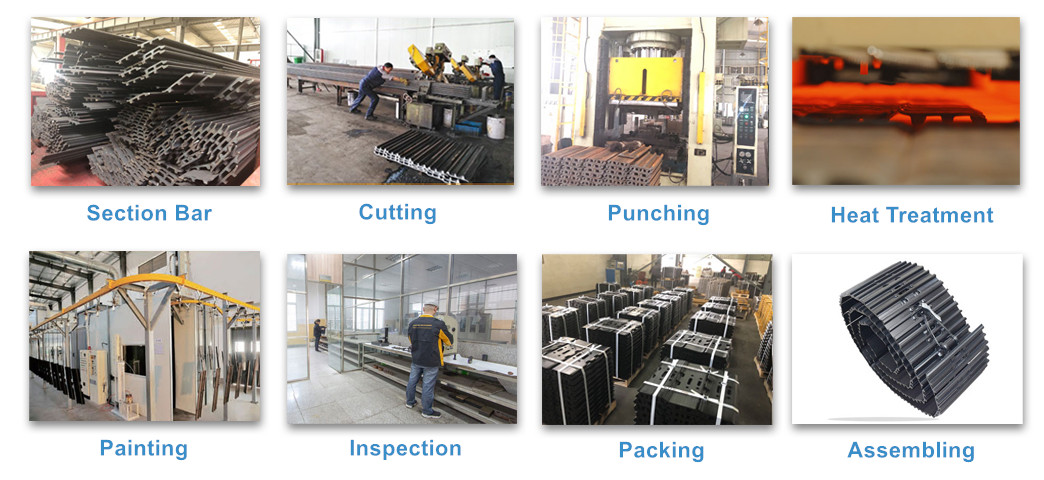
Yintparts describes a quality control process covering raw material sourcing, design, manufacturing, machining, and final packing. Its published manufacturing process also shows operations such as cutting, punching, heat treatment, painting, inspection, and packing. This type of process-based quality control is important because product defects should be prevented and identified throughout production, not only during the final appearance check.
When purchasing excavator track shoe assemblies in bulk, buyers should request relevant quality documents rather than relying entirely on verbal confirmation. These records help verify whether the delivered products meet the agreed technical requirements.
A practical quality document checklist includes:
For large orders, buyers may also arrange first-article inspection before mass production and sample-based inspection before shipment. The sampling quantity and acceptance criteria should be agreed in advance according to the order size, product risk, and quality requirements.
For a broader view of manufacturing capabilities and quality inspection facilities, buyers can review the Yintparts manufacturer profile before evaluating a potential supplier.
Xiamen Yintai Machinery Co., Ltd. (Yintparts) specializes in excavator and bulldozer undercarriage components, including track shoes, track link groups, rollers, idlers, sprockets, and other replacement parts. The company supplies products for machinery brands such as Caterpillar, Komatsu, Hitachi, Daewoo, and Volvo.
For track shoe production, Yintparts highlights the use of high-grade steel, spray quenching, tempering, and quality control throughout the manufacturing process. The company also offers customized products according to customer drawings, samples, and specific requirements.
Its product range includes excavator track pads, bulldozer single-grouser shoes, swamp shoes, and welded track shoe designs. Different products are intended for different machines and operating conditions, so confirming the application and technical specifications is an important part of the purchasing process.
When requesting a quotation from Yintparts, buyers can provide the machine brand, model, part number, required quantity, and original drawing or sample. These details help the manufacturer confirm product compatibility and discuss the relevant material, dimensions, and inspection requirements before production.
A reliable track shoe assembly is not determined by one inspection result. Material quality, dimensional accuracy, heat treatment, fastening or welding quality, and final inspection must work together. By checking these factors before shipment, buyers can make more informed purchasing decisions and reduce the risk of undercarriage problems during operation.
What are the most important quality checks for excavator track shoe assemblies?
The main checks include raw material verification, dimensional inspection, hardness testing, heat treatment quality, grouser profile, bolt-hole accuracy, fastener compatibility, welding inspection where applicable, and final surface inspection. Buyers should also request relevant quality records before shipment.
Which steel is commonly used for excavator track shoes?
25MnB is one of the steel grades used for excavator track shoes. The appropriate material depends on the product design, machine application, required mechanical properties, and manufacturer's technical specification.
How do buyers check the hardness of excavator track pads?
Buyers can use a calibrated hardness tester to measure representative positions on the product. The results should be compared with the agreed hardness specification, taking the material, heat treatment process, and testing method into account.
Why is dimensional accuracy important for track shoe assemblies?
Correct dimensions ensure that the track shoes fit the track links and machine installation requirements. Incorrect plate width, thickness, pitch, or bolt-hole spacing can cause installation difficulties and affect track system performance.
What is the difference between a track shoe and a track link group assembly?
A track shoe is the individual ground-contacting plate attached to the crawler track. A track link group assembly is a larger undercarriage component that can include track links, track shoes, bolts, and nuts. Buyers should confirm which product configuration they need before ordering.
Can Yintparts manufacture customized excavator track shoes?
Yes. Yintparts offers customized track shoes according to customer drawings, samples, and technical requirements. Buyers should provide the machine model, part number, installation dimensions, and application details to help confirm the correct product.
get latest company news
Xiamen Yintai Machinery Co., Ltd


 ipv6 network supported
 sales & support 8613696958576
 Email : binochen@yintparts.com